


Filed under: Evangelium Vitae
AROUND THE WORLD AND THROUGH THE CENTURIES WITH THE UNBORN CHRIST CHILD
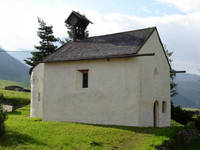
Chapel of St. Leonard Nauders Austria
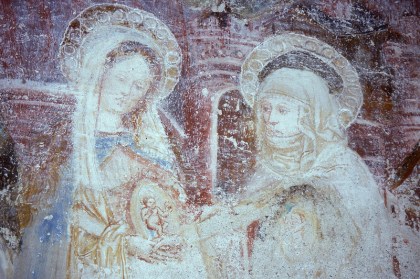
Maria Heimsuchung – One of Three Frescoes found in the Chapel of St. Leonard
The wall paintings in the Chapel of St. Leonard are among the most important Romanesque frescoes discoveries that have been made in North Tyrol ever. Their rediscovery goes back to 1914. Although the paintings are not completely preserved, they are among the earliest frescoes of North Tyrol and thus are important in Austria’s art history. The latest research link these frescos to benchmark examples in South Tyrol and Graubünden and assume that the frescoes were created by 1210.
“Truly He is in haste to be about His Father’s business. Truly He is an impatient conqueror, to be thus early beginning His conquests, and laying the foundations of His world wide empire. He can not bear to be in the world for even so short a while, but sin shall feel the weight of His unborn arm…..His first mission and ministry was in the womb, and the babe unborn the first conquest of His divine apostolate…..and the Unborn Child destroys the sin and abolishes the curse of the unborn child.” Frederick W. Faber, D.D., The Blessed Sacrament (Baltimore, MD: John Murphy Company, circa 1855), 162 163.
ANNUNCIATION OF USTYUG 1119-1130, THE TRETYAKOV GALLERY MOSCOW, RUSSIA
December 3, 2012, 10:35 pm | Edit this
Filed under: Advent, Incarnation, Mother of the Lord, The Incarnation, Unborn Jesus
AROUND THE WORLD AND THROUGH THE CENTURIES WITH THE UNBORN CHRIST CHILD
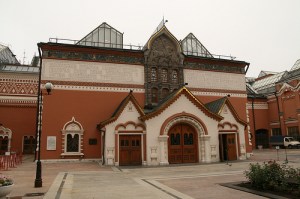
The Tretyakov Gallery
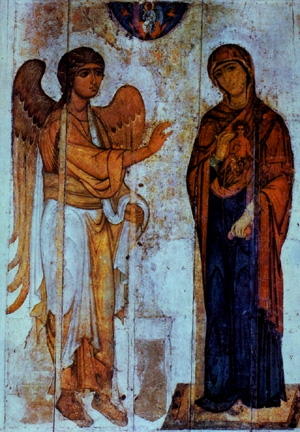
One of the earliest images of Christ in the womb is the Annunciation of Ustyug
The Annunciation of Ustyug gained its name due to the legend that Saint Procopius of Ustyug predicted the fall of a meteorite and other calamities near the town of Veliky Ustyug. He tried to convince the citizens to confess their sins and pray for the city to be saved. They did not believe him and only at the last minute, when the storm had already started, escaped to the church and started to pray before the icon and were saved.
The icon depicts Christ Emmanuel standing In the womb of the Virgin, giving a blessing with his right hand. On the left – the archangel Gabriel, greets the Virgin Mary and is blessing her. At the top of the center, in a blue semi-circle of the sky with gold stars the Father is portrayed with a blue halo of glory. He sits on a red throne, at the foot of which are red cherubim, and above on the sides – red and gold Seraphim. The Father holds a scroll in his left hand, and His right hand blesses Mary.
The Ustyug Annunciation in its iconography has its roots in Eastern Christian art. The point of this type of art is to explain the supernatural Conception – Incarnation of the deity. Therefore, in Russia, the Virgin with the Christ child depicted near her heart is sometimes called Our Lady of the Incarnation.
“For you must know that the sublime work of the Incarnation was the work of the whole Trinity, although it was only the Person of the Son of God who became incarnate. It was as if one who put on a tunic were helped by two standing on either side of him who held the tunic in their hands….For although the Holy Trinity is every where, nevertheless you must think of It in your meditation as being here in a very special manner, by reason of the great and unique work which is being done.” St. Bonaventure, Meditations On The Life Of Christ, trans. Sister M. Emmanuel, O.S.B. (St. Louis, MO: B. Herder Book Co., 1934), 16.
Filed under: Unborn Jesus
AROUND THE WORLD AND THROUGH THE CENTURIES WITH THE UNBORN CHRIST CHILD
The Tretyakov Gallery
One of the earliest images of Christ in the womb is the Annunciation of Ustyug
The Annunciation of Ustyug gained its name due to the legend that Saint Procopius of Ustyug predicted the fall of a meteorite and other calamities near the town of Veliky Ustyug. He tried to convince the citizens to confess their sins and pray for the city to be saved. They did not believe him and only at the last minute, when the storm had already started, escaped to the church and started to pray before the icon and were saved.
The icon depicts Christ Emmanuel standing In the womb of the Virgin, giving a blessing with his right hand. On the left – the archangel Gabriel, greets the Virgin Mary and is blessing her. At the top of the center, in a blue semi-circle of the sky with gold stars the Father is portrayed with a blue halo of glory. He sits on a red throne, at the foot of which are red cherubim, and above on the sides – red and gold Seraphim. The Father holds a scroll in his left hand, and His right hand blesses Mary.
The Ustyug Annunciation in its iconography has its roots in Eastern Christian art. The point of this type of art is to explain the supernatural Conception – Incarnation of the deity. Therefore, in Russia, the Virgin with the Christ child depicted near her heart is sometimes called Our Lady of the Incarnation.
“For you must know that the sublime work of the Incarnation was the work of the whole Trinity, although it was only the Person of the Son of God who became incarnate. It was as if one who put on a tunic were helped by two standing on either side of him who held the tunic in their hands….For although the Holy Trinity is every where, nevertheless you must think of It in your meditation as being here in a very special manner, by reason of the great and unique work which is being done.” St. Bonaventure, Meditations On The Life Of Christ, trans. Sister M. Emmanuel, O.S.B. (St. Louis, MO: B. Herder Book Co., 1934), 16.
Filed under: Evangelium Vitae
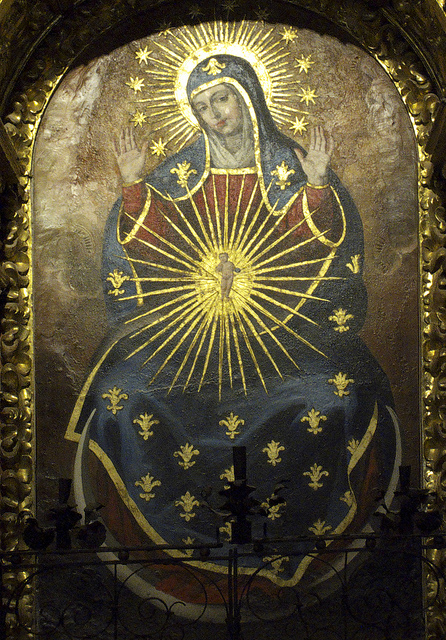
VIRGIN MARY “OF THE SIGN”, 15TH CENTURY, MEZQUITA CATHEDRAL, ANDALUSIA CORDOBA, SPAIN
In his Apostolic Exhortaion entitled Vita Consecrata (March 25, 1996) John Paul II has a thought provoking quote from St. Augustine:
“Beautiful is God, the Word with God … He is beautiful in heaven, beautiful on earth; beautiful in the womb, beautiful in his parents’ arms, beautiful in his miracles, beautiful in his sufferings; beautiful in inviting to life, beautiful in not worrying about death, beautiful in giving up his life and beautiful in taking it up again; he is beautiful on the Cross, beautiful in the tomb, beautiful in heaven. Listen to the song with understanding, and let not the weakness of the flesh distract your eyes from the splendour of his beauty.” #24
Filed under: Evangelium Vitae
Memory is a faculty of the soul. The human memory has a great dignity about it, as part of our intellect – but it is driven, in a sense by the will, by the human heart. St Paul reminded his Christian friends in Philippi; “Whatever is true, whatever is honorable, whatever is just, whatever is pure, whatever is lovely, whatever is gracious, if there is any excellence, if there is anything worthy of praise, think about these things.” (Phil 4.8) So too, I am sure Paul would agree; remember these things!
A few years ago UnbornWordoftheday.com did a series of 6 posts reflecting on Mary’s memory of the early events of our Lord’s life; His unborn life within her initially, and then during His newborn period. [Links provided below.] As John Paul II said, “Mary is the memory of the Church.”
Similarly, each Pro-Life person is the memory of an enduring Culture of Life, that is born of the human soul first of all, but that is inspired and lifted up by revealed Christian faith as well. The eight point list St Paul gives us in Philippians is a superb guide to understanding – and recalling to mind – the wonderful Culture of Life that each Pro-Life person has witnessed and experienced. Our Respect-for-Life memory is in essence holy, going back long before the Roe vs. Wade decision of forty years ago. Likewise, the Pro-Life memory is sustained not only by human dignity, history and personal experience but, because it is holy in many respects, it is sustained too by Almighty God.
As Mary carried a germinating Credo of Christian faith within her heart – while carrying the Christ within her womb – so too each Pro-Life person carries within his/her heart a Culture of Life memory. Or rather you have been entrusted with this Gospel of Life, to carry it forward as a light; first as a light of memory to strengthen you in your own faith life, and secondly as a light to the nations to guide them back from the shipwrecked shoals of their culture of death, back to the Way that is: True, Honorable, Just, Pure, Lovely, Gracious, Excellent and Worthy of Praise.
IN HER WOMB A DEVELOPING CHILD, IN HER HEART A DEVELOPING CREED – SHE EMBRACES BOTH!
THE GERMINATING CHRISTIAN CREED WAS REVEALED TO MARY INCREMENTALLY DURING HER PREGNANCY
MARY’S MAGNIFICAT IS A GLIMPSE INTO THE CREED TAKING HOLD IN HER HEART
GOD USES ZECHARIAH TO INSTRUCT MARY
AN ANGEL SPEAKS TO JOSEPH – MARY IS THE FIRST PERSON HE TELLS!
CAESAR AUGUSTUS & THE PROPHET MICAH SHOW MARY GOD’S PLAN
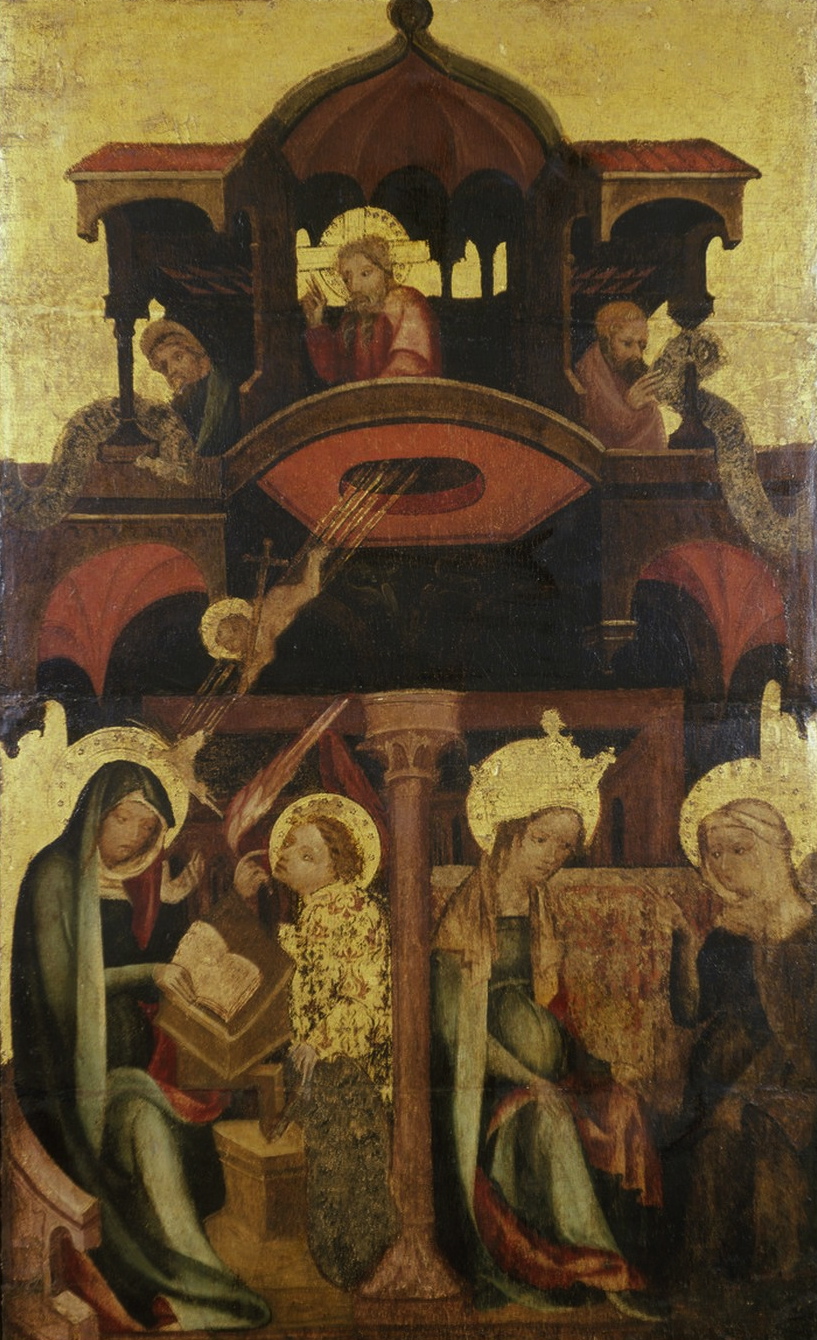
The Annunciation and Visitation of Mary
Altarflügel mit der Verkündigung und der Heimsuchung
- HAVE YOU GIVEN YOUR HEART TO JESUS?
- HAVE YOU ACCEPTED JESUS CHRIST AS YOUR LORD AND SAVIOR?
Many Christians consider these to be important questions concerning one’s relationship withGod. Baptism – according to the instruction of Jesus and the practice of both the early and contemporary Church –establishes a solid relationship with God. But when Mary first encountered Jesus Christ, there was no Christian baptism. Also, the Church’s teaching about Mary’s Immaculate Conception, while perhaps implied in the Gospel is not explicitly demonstrated there. So let’s look simply at the Gospel and what it tells us about Mary and these 2 questions.
- Have you given your heart to Jesus?
According to the Gospel of Luke, Mary had a wonderful deep relationship with the God of Abraham, Isaac and Jacob. When the Archangel Gabriel appeared to Mary he stated that she was “full of grace”, that “the Lord is with you” and that she had “found favor with God” (Lk 1:28,30). A threefold acknowledgement of Mary’s profound and faithful relationship to God. Gabriel then outlines for her the role Almighty God wants her to accept in the great Incarnation Mission of His Son. Her fiat – “Let it be to me according to your word” (Lk 1:38) – invites God into human history; immediately thereafter Christ is conceived in her womb by the power of the Holy Spirit. The early Church Fathers were so impressed by this definitive openness of Mary to the will of God that they would say that Mary conceived Christ in her mind and heart before she conceived Him in her womb. Hence, going back to the above question – Mary was the First person to give her heart to Jesus
2. Have you accepted Jesus Christ as your Lord and Savior?
Mary answers this question at the event we call The Visitation (celebrated on May 31st), where she visits her cousin Elizabeth (and unborn John the Baptist….and Elizabeth’s husband Zechariah). First, we see that Elizabeth is “filled with the Holy Spirit” and blesses Mary for her great faith. Then Mary responds with her famous Magnificat, which begins with the words:
“My soul doth magnify the Lord, and my spirit hath rejoiced in God my Saviour.” (KJV translation)
Note the two words; Lord & Savior! Mary had already accepted Jesus Christ as her Lord and Savior – according to Scripture – about a week after Unborn Jesus had been conceived in her womb (if not earlier)! Again, Mary is the First person to accept Jesus Christ as her Lord and Savior!
Of course this wondrous relationship between Mary and her Son would continue to unfold and strengthen. She gave birth to Him (Lk 2:1-20), she flees to Egypt to protect Him from persecution (Mt 2:13-15), she raises Him with tender love, she encourages Him to perform His first miracle sign (Jn 2:1-12), she even stands at the foot of the cross as our Lord and Savior dies for us (Jn 19:25), Her Son entrusts His disciples to her maternal care from the Cross Jn 19:26-27), and she is with the early Church – praying – on the day of Pentecost (Acts 1:12-15).
No wonder then, that Mary is recognized not only as the First Believer to believe in Jesus, but also as the First Christian to love Jesus.
“Among the vulnerable for whom the Church wishes to care with particular love and concern are unborn children, the most defenseless and innocent among us. Nowadays efforts are made to deny them their human dignity and to do with them whatever one pleases, taking their lives and passing laws preventing anyone from standing in the way of this. Frequently, as a way of ridiculing the Church’s effort to defend their lives, attempts are made to present her position as ideological, obscurantist and conservative. Yet this defense of unborn life is closely linked to the defense of each and every other human right. It involves the conviction that a human being is always sacred and inviolable, in any situation and at every stage of development. Human beings are ends in themselves and never a means of resolving other problems. Once this conviction disappears, so do solid and lasting foundations for the defense of human rights, which would always be subject to the passing whims of the powers that be. Reason alone is sufficient to recognize the inviolable value of each single human life, but if we also look at the issue from the standpoint of faith, ‘every violation of the personal dignity of the human being cries out in vengeance to God and is an offence against the creator of the individual’.
Precisely because this involves the internal consistency of our message about the value of the human person, the Church cannot be expected to change her position on this question. I want to be completely honest in this regard. This is not something subject to alleged reforms or “modernizations”. It is not “progressive” to try to resolve problems by eliminating a human life. On the other hand, it is also true that we have done little to adequately accompany women in very difficult situations, where abortion appears as a quick solution to their profound anguish, especially when the life developing within them is the result of rape or a situation of extreme poverty. Who can remain unmoved before such painful situations?”
From THE JOY OF THE GOSPEL POPE FRANCIS # 213-214
Filed under: Biblical Reflections, Culture of LIfe, John Paul II, Quotes from Great Christians, Saints, Unborn Jesus
VIRGIN MARY “OF THE SIGN”, 15TH CENTURY, MEZQUITA CATHEDRAL, ANDALUSIA CORDOBA, SPAIN
In his Apostolic Exhortaion entitled Vita Consecrata (March 25, 1996) John Paul II has a thought provoking quote from St. Augustine:
“Beautiful is God, the Word with God … He is beautiful in heaven, beautiful on earth; beautiful in the womb, beautiful in his parents’ arms, beautiful in his miracles, beautiful in his sufferings; beautiful in inviting to life, beautiful in not worrying about death, beautiful in giving up his life and beautiful in taking it up again; he is beautiful on the Cross, beautiful in the tomb, beautiful in heaven. Listen to the song with understanding, and let not the weakness of the flesh distract your eyes from the splendour of his beauty.” #24
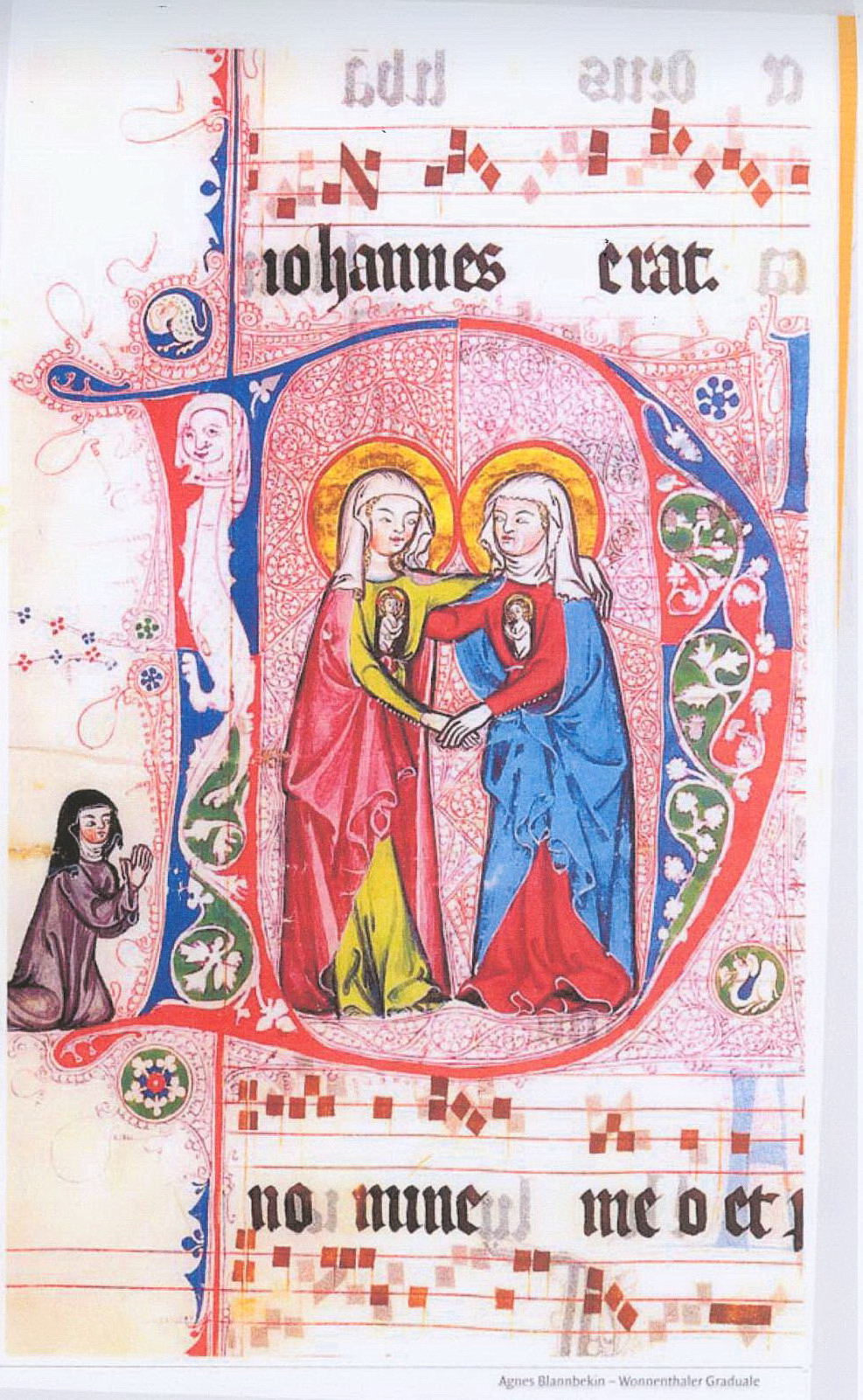
May 31, 2013 is the Feast of the Visitation. About one week after conceiving Jesus by the power of the Holy Spirit, and at the conclusion of a 4 day journey, Mary arrives at the home of Elizabeth and Zechariah. We present two reflections: 1. Theological, 2. Poetical.
“John (the Baptist) was ‘filled with the Holy Spirit even from his mother’s womb’ by Christ himself, whom the Virgin Mary had just conceived by the Holy Spirit. Mary’s visitation to Elizabeth thus became a visit from God to his people.” Catechism of the Catholic Church #717
The Quickening of St. John the Baptist – Written in 1949
On the Contemplative Vocation
Why do you fly from the drowned shores of Galilee,
From the sands and the lavender water?
Why do you leave the ordinary world, Virgin of Nazareth,
The yellow fishing boats, the farms,
The winesmelling yards and low cellars
Or the oilpress, and the women by the well?
Why do you fly those markets,
Those suburban gardens,
The trumpets of the jealous lilies,
Leaving them all, lovely among the lemon trees?
You have trusted no town
With the news behind your eyes.
You have drowned Gabriel’s word in thoughts like seas
And turned toward the stone mountain
To the treeless places.
Virgin of God, why are your clothes like sails?
The day Our Lady, full of Christ,
Entered the dooryard of her relative
Did not her steps, light steps, lay on the paving leaves
like gold?
Did not her eyes as grey as doves
Alight like the peace of a new world upon that house, upon
miraculous Elizabeth?
Her salutation
Sings in the stone valley like a Charterhouse bell:
And the unborn saint John
Wakes in his mother’s body,
Bounds with the echoes of discovery.
Sing in your cell, small anchorite!
How did you see her in the eyeless dark?
What secret syllable
Woke your young faith to the mad truth
That an unborn baby could be washed in the Spirit of God?
Oh burning joy!
What seas of life were planted by that voice!
With what new sense
Did your wise heart receive her Sacrament,
And know her cloistered Christ?
You need no eloquence, wild bairn,
Exulting in your hermitage.
Your ecstasy is your apostolate,
For whom to kick is contemplata tradere.
Your joy is the vocation of Mother Church’s hidden children –
Those who by vow lie buried in the cloister or the hermitage;
The speechless Trappist, or the grey, granite Carthusian,
The quiet Carmelite, the barefoot Clare, Planted in the night of
contemplation, Sealed in the dark and waiting to be born.
Night is our diocese and silence is our ministry
Poverty our charity and helplessness our tongue-tied
sermon.
Beyond the scope of sight or sound we dwell upon the air
Seeking the world’s gain in an unthinkable experience.
We are exiles in the far end of solitude, living as listeners
With hearts attending to the skies we cannot understand:
Waiting upon the first far drums of Christ the Conqueror,
Planted like sentinels upon the world’s frontier.
But in the days, rare days, when our Theotokos
Flying the prosperous world
Appears upon our mountain with her clothes like sails,
Then, like the wise, wild baby,
The unborn John who could not see a thing
We wake and know the Virgin Presence
Receive her Christ into our night
With stabs of an intelligence as white as lightning.
Cooled in the flame of God’s dark fire
Washed in His gladness like a vesture of new flame
We burn like eagles in His invincible awareness
And bound and bounce with happiness,
Leap in the womb, our cloud, our faith, our element,
Our contemplation, our anticipated heaven
Till Mother Church sings like an Evangelist.
Filed under: Culture of LIfe, John Paul II, Mother of the Lord, The Incarnation, Unborn Jesus
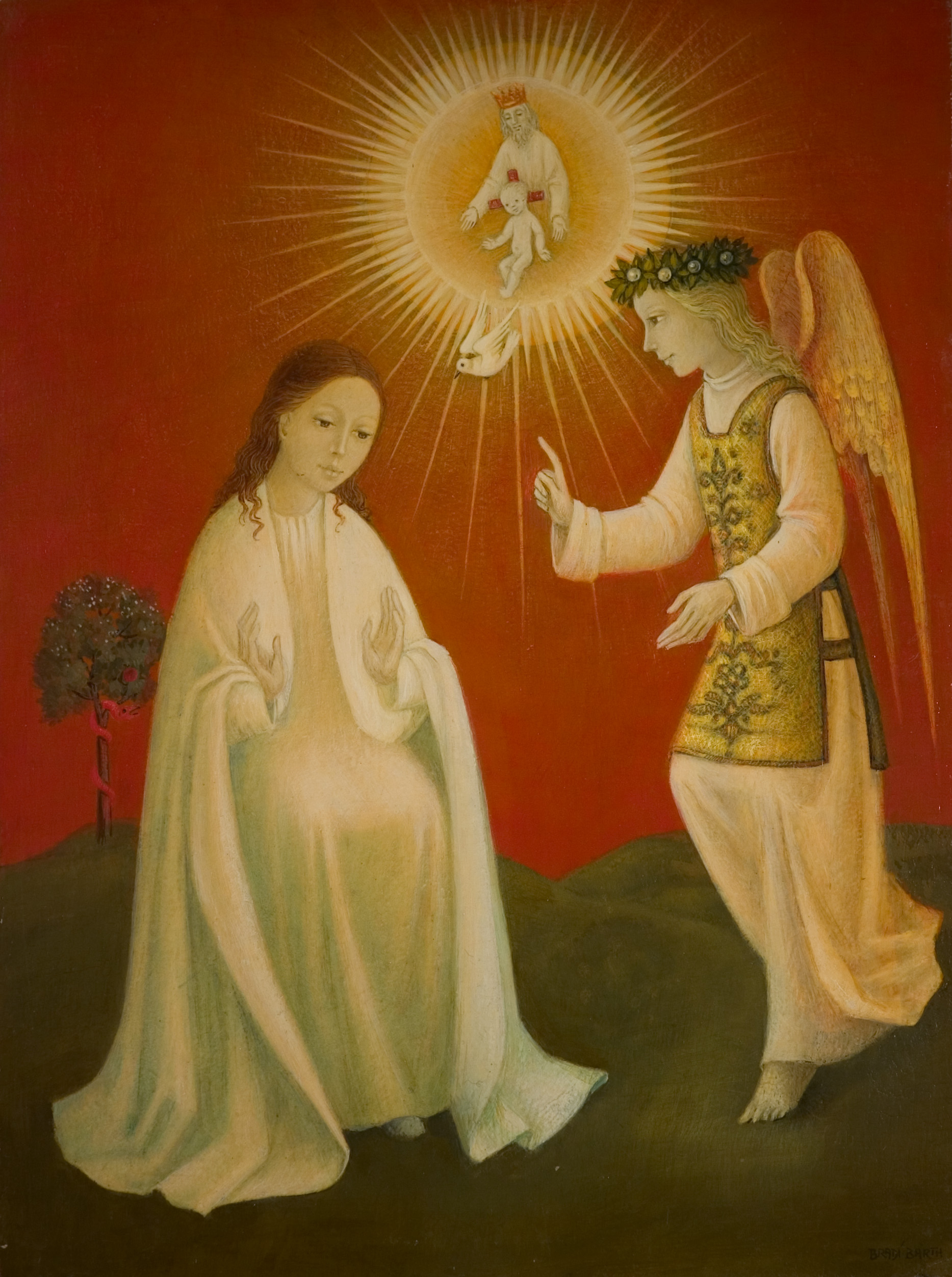
Annunciation by Bradi Barth
This year, because March 25th fell in Holy Week, the great feast day of the Annunciation of the Lord to Mary has been moved to Monday April 8, 2013. This feast day also marks the Incarnation of Christ our Lord. Due to this date change, Divine Mercy Sunday (the 7th) and the Annunciation (the 8th) are back-to-back.
This fact draws our attention to the incredible testimony to the Mercy of God contained within the mystery of the Incarnation of Jesus Christ. At the beginning of his 1980 encyclical letter Dives in Misericordia, On the Mercy of God, John Paul II recounts the understanding of God’s mercy found in the Old Testament, then he comments:
“Christ confers on the whole of the Old Testament tradition about God’s mercy a definitive meaning. Not only does He speak of it and explain it by the use of comparisons and parables, but above all He Himself makes it incarnate and personifies it. He Himself, in a certain sense, is mercy.” (#2)
Later in this same encyclical John Paul II speaks of Christ’s messianic program as a program of mercy, relying upon the prophet Isaiah to help define it as “the revelation of merciful love for the poor, the suffering and prisoners, for the blind, the oppressed and sinners”. (#8)
Mercy is etched upon the life of Christ from Incarnation to Ascension. We are all daily beneficiaries of His program of Mercy. But John Paul II goes a step further: “Christ’s messianic program, the program of mercy, becomes the program of His people, the program of the Church.” (#8)
The worldwide Pro-Life community has always identified itself with the Mercy and forgiveness of God and must continue to emphasize this Program of Mercy. In the unborn and newborn Christ Child we see that God’s mercy is humble, vulnerable and therefore open to misinterpretation as mere weakness. But the Christ child’s humility and vulnerability, like Mercy and forgiveness are expressions of the redemptive power of God. The Pro – Life movement must continue to reflect mercy and forgiveness, in order to reach out to those most invested in so-called “abortion rights” and the destruction of humble, vulnerable human life.
Memory is a faculty of the soul. The human memory has a great dignity about it, as part of our intellect – but it is driven, in a sense by the will, by the human heart. St Paul reminded his Christian friends in Philippi; “Whatever is true, whatever is honorable, whatever is just, whatever is pure, whatever is lovely, whatever is gracious, if there is any excellence, if there is anything worthy of praise, think about these things.” (Phil 4.8) So too, I am sure Paul would agree; remember these things!
A few years ago UnbornWordoftheday.com did a series of 6 posts reflecting on Mary’s memory of the early events of our Lord’s life; His unborn life within her initially, and then during His newborn period. [Links provided below.] As John Paul II said, “Mary is the memory of the Church.”
Similarly, each Pro-Life person is the memory of an enduring Culture of Life, that is born of the human soul first of all, but that is inspired and lifted up by revealed Christian faith as well. The eight point list St Paul gives us in Philippians is a superb guide to understanding – and recalling to mind – the wonderful Culture of Life that each Pro-Life person has witnessed and experienced. Our Respect-for-Life memory is in essence holy, going back long before the Roe vs. Wade decision of forty years ago. Likewise, the Pro-Life memory is sustained not only by human dignity, history and personal experience but, because it is holy in many respects, it is sustained too by Almighty God.
As Mary carried a germinating Credo of Christian faith within her heart – while carrying the Christ within her womb – so too each Pro-Life person carries within his/her heart a Culture of Life memory. Or rather you have been entrusted with this Gospel of Life, to carry it forward as a light; first as a light of memory to strengthen you in your own faith life, and secondly as a light to the nations to guide them back from the shipwrecked shoals of their culture of death, back to the Way that is: True, Honorable, Just, Pure, Lovely, Gracious, Excellent and Worthy of Praise.
Because human life is a gift from God and sacred, our Culture of Life memory is stronger than death and holy.
IN HER WOMB A DEVELOPING CHILD, IN HER HEART A DEVELOPING CREED – SHE EMBRACES BOTH!
THE GERMINATING CHRISTIAN CREED WAS REVEALED TO MARY INCREMENTALLY DURING HER PREGNANCY
MARY’S MAGNIFICAT IS A GLIMPSE INTO THE CREED TAKING HOLD IN HER HEART
GOD USES ZECHARIAH TO INSTRUCT MARY
AN ANGEL SPEAKS TO JOSEPH – MARY IS THE FIRST PERSON HE TELLS!
CAESAR AUGUSTUS & THE PROPHET MICAH SHOW MARY GOD’S PLAN
Filed under: Biblical Reflections, How are we to honor Unborn Jesus, Mother of the Lord, Prayer
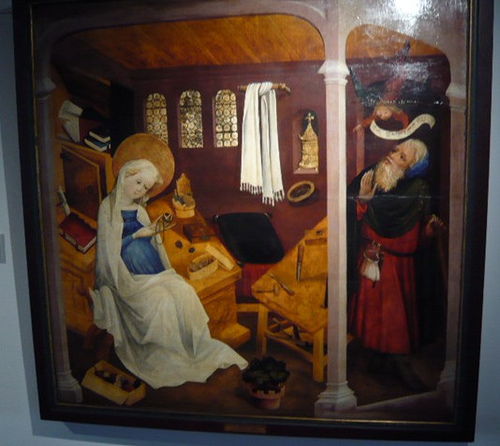
In the second chapter of Luke we are told on four different occasions how Mary (and Joseph) react and feel about words and events surrounding the birth, infancy and childhood of Jesus. Luke thus introduces us to the overlapping and harmonizing psychology and spirituality of Mary (and Joseph). This is instructive for the modern everyday Christian.
The angels appear to poor uneducated shepherds and entrust to them a proclamation for the entire world, for all time. The shepherds go down the hill and find the manger, and start recounting the words spoken to them about this Child; “all who heard it wondered”. Then the next verse, “But Mary kept all these things, pondering them in her heart” (Lk 2.19).
Eight days later, Mary and Joseph bring Jesus to the Temple. The holy man Simeon is inspired by the Holy Spirit to go to the Temple and speak to them about the Child. Luke specifically tells us that Joseph and Mary “marveled at what was said about him (the Child)” (Lk 2.33).
About twelve years later, Mary and Joseph bring the boy Jesus to Jerusalem for the Passover feast. Jesus becomes separated from them, and His parents seek “anxiously” for Him. After three days they find Him in the Temple and He was questioning and listening to the teachers. “All who heard him were amazed”. Luke then specifically says about Joseph and Mary; “And when they saw him they were astonished…” (Lk 2.48).
Luke continues to recount this story about the finding of the boy Jesus in the Temple, advises that they all returned to Nazareth and Jesus was obedient to His parents, then this; “…and Mary kept all these things in her heart” (Lk 2.51).
In the 2nd chapter of Luke’s Gospel we are given a glimpse into the spiritual and devotional life of Mary. (This follows up on the 1st chapter presentation of Mary’s Magnificat, which similarly offers a window into the soul of Mary.)
In the Manger and in Nazareth Mary ponders, contemplates in the depths of her heart. In the Temple Mary is awestruck; marveling with astonishment. Mary interiorizes the remarkable truths and teachings about Jesus Christ, she will learn from them, grow in them, mature through them.
Mary lives the Gospel events as no other could, as no other did. As John Paul II says of her, she is the “memory” of the Church, and indeed she will share these events and meanings with the Church in due course.
The Litany in Honor of Mary the First Christian summarizes the scriptural recounting of the numerous Gospel events lived and uniquely experienced by Mary in her lifelong relationship with her most beloved Son Jesus Christ. 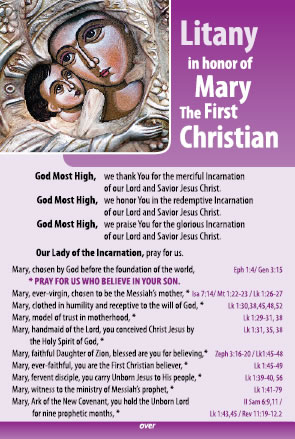
Click here to order a free copy of Litany.
Filed under: Christmas
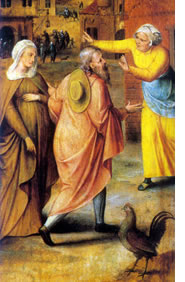
The Virgin and St. Joseph Refused Shelter in Bethlehem Jan Massys 1558
We want to wish all of you a Merry Christmas and a Happy New Year.
As many of you know this is the Year of Faith. Pope Benedict spoke eloquently this Christmas Eve asking us to find time for Jesus in the room of our hearts and minds. Here is the what he said:
“Do we have time and space for him? Do we not actually turn away God himself? We begin to do so when we have no time for him,”
“The faster we can move, the more efficient our time-saving appliances become, the less time we have. And God? The question of God never seems urgent. Our time is already completely full. Even if he seems to knock at the door of our thinking, he has to be explained away. If thinking is to be taken seriously, it must be structured in such a way that the ‘God hypothesis’ becomes superfluous,” he said. “There is no room for him. Not even in our feelings and desires is there any room for him. We want ourselves. We want what we can seize hold of, we want happiness that is within our reach, we want our plans and purposes to succeed. We are so ‘full’ of ourselves that there is no room left for God.”
I know when I read this it struck me as so true. Our world is structured in such a way that it seems to squeeze Christ out of our lives. There was no room for Christ at the Inn in Bethlehem 2000 years ago – let us resolve anew to open our hearts and minds to make room for Him in this Year of Faith.
AROUND THE WORLD AND THROUGH THE CENTURIES WITH THE UNBORN CHRIST CHILD
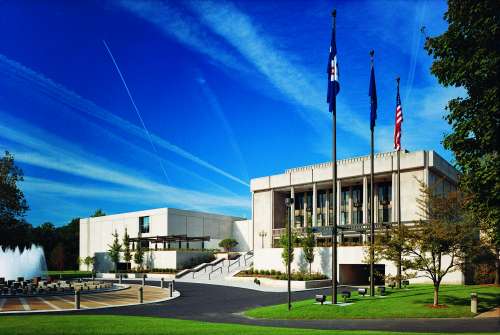
Indianapolis Museum of Art
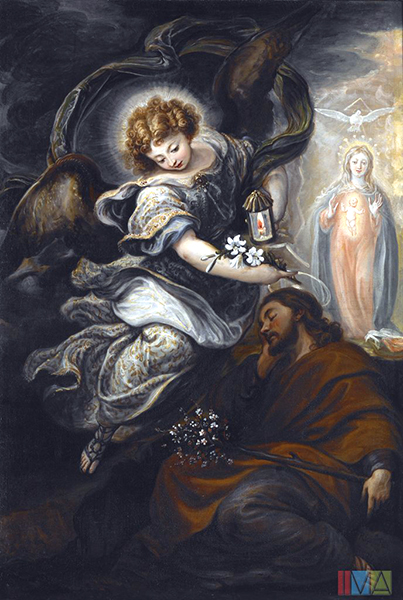
The Dream of St. Joseph Artist: Francisco Rizi
In a subject that became popular in Spain during the 17th century, an angel appears to St. Joseph in a dream and explains that Mary has miraculously conceived a child. The luminous angel points to a vision of Mary with the infant Christ in her womb and the dove of the Holy Spirit above her. The veneration of the expectant Virgin as protectress of women in childbirth was prevalent at the Spanish court and was promoted by the royal confessor. Francisco Rizi was the Spanish-born son of a Bolognese painter who went to work for Philip II at the Escorial in 1583. Rizi, who became royal painter to Philip IV in 1658, was also active as a stage designer.
“An angel of the Lord appeared to him in a dream, saying, ‘Joseph, son of David, do not fear to take Mary your wife, for that which is conceived in her is of the Holy Spirit; she will bear a son, and you shall call his name Jesus, for he will save his people from their sins’ (Mt 1:20-21).
There is a strict parallel between the “annunciation” in Matthew’s text and the one in Luke. The divine messenger introduces Joseph to the mystery of Mary’s motherhood. While remaining a virgin, she who by law is his “spouse” has become a mother through the power of the Holy Spirit. And when the Son in Mary’s womb comes into the world, he must receive the name Jesus. This was a name known among the Israelites and sometimes given to their sons. In this case, however, it is the Son who, in accordance with the divine promise, will bring to perfect fulfillment the meaning of the name Jesus-Yehos ua’ – which means ‘God saves.’ “ John Paul II, Redemptoris Custos
AROUND THE WORLD AND THROUGH THE CENTURIES WITH THE UNBORN CHRIST CHILD
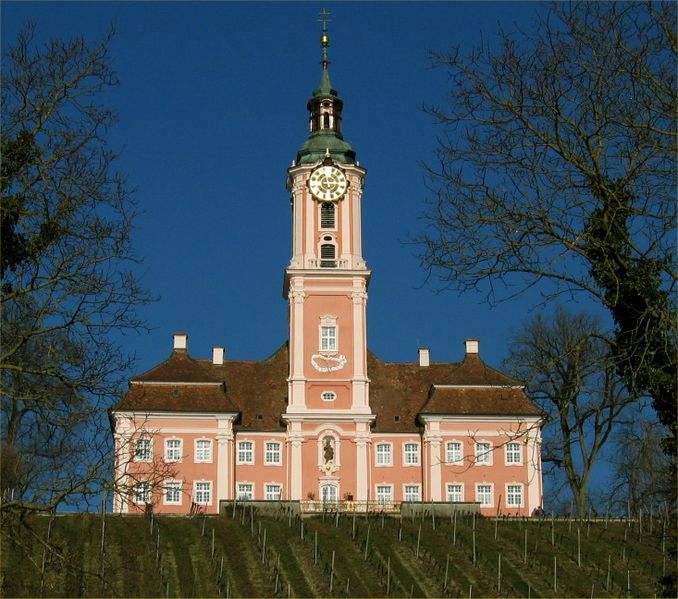
Die Wallfahrtskirche Birnau (The Pilgrimage Church of Birnau)
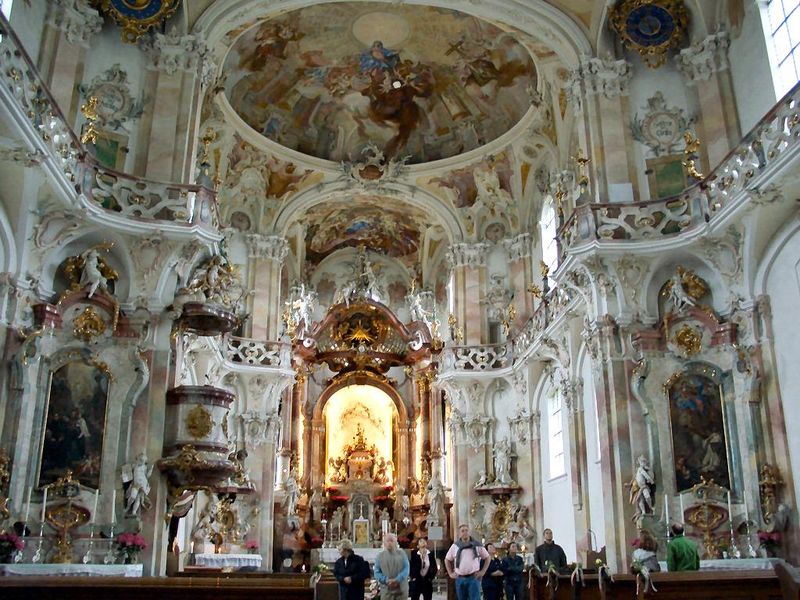

Apokalypse Maria-Ekklesia (Presbyteriu Deckenfresko)
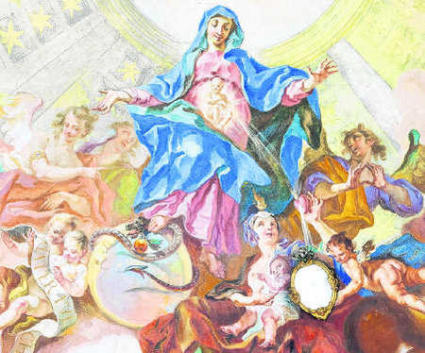
Detail of Christ In the Womb
Birnau is a pilgrimage church at the shore of Lake Constance, between Meersburg and Überlingen. It was built in 1746-1749 for the Cistercians monastery of Salem (Germany) by Austrian architect Peter Thumb. The church interior features notable frescoes by Gottfried Bernhard Göz as well as altars and stucco ornaments in rococo style by Joseph Anton Feuchtmayer.
“In being born among us, may the Child Jesus not find us distracted or merely busy, beautifying our houses with decorative lights. Rather, let us deck our soul and make our families a worthy dwelling place where he feels welcomed with faith and love. May the Blessed Virgin and St Joseph help us to live the Mystery of Christmas with renewed wonder and peaceful serenity.” Benedict XVI General Audience, December 20 2006
AROUND THE WORLD AND THROUGH THE CENTURIES WITH THE UNBORN CHRIST CHILD
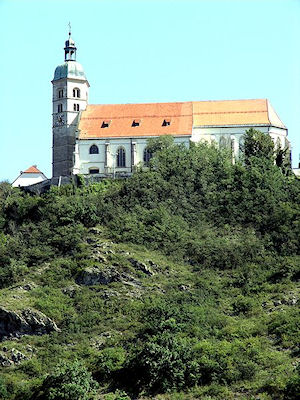
The Sanctuary of St. Mary of the Assumption (Pilgrimage church Mariä Himmelfahrt)
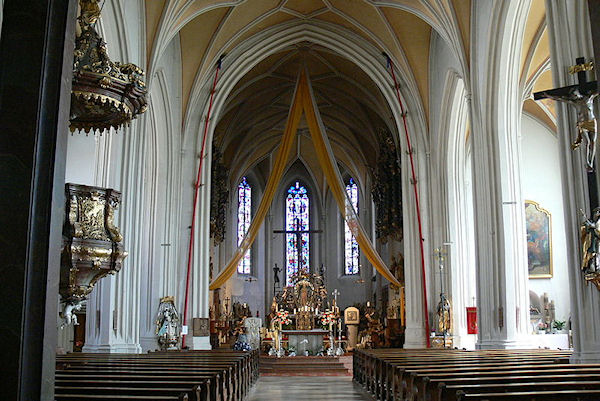
The Sanctuary of St. Mary of the Assumption (Mariä Himmelfahrt) Shrine Interior
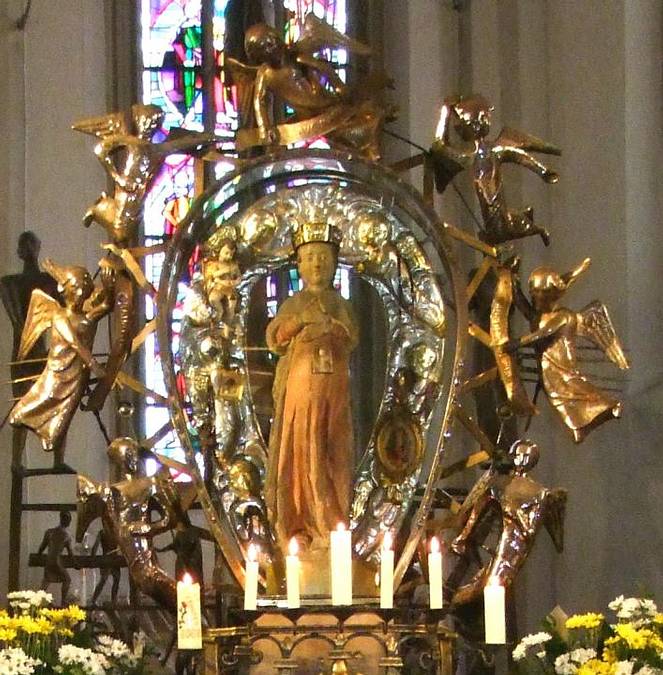
Pregnant Madonna
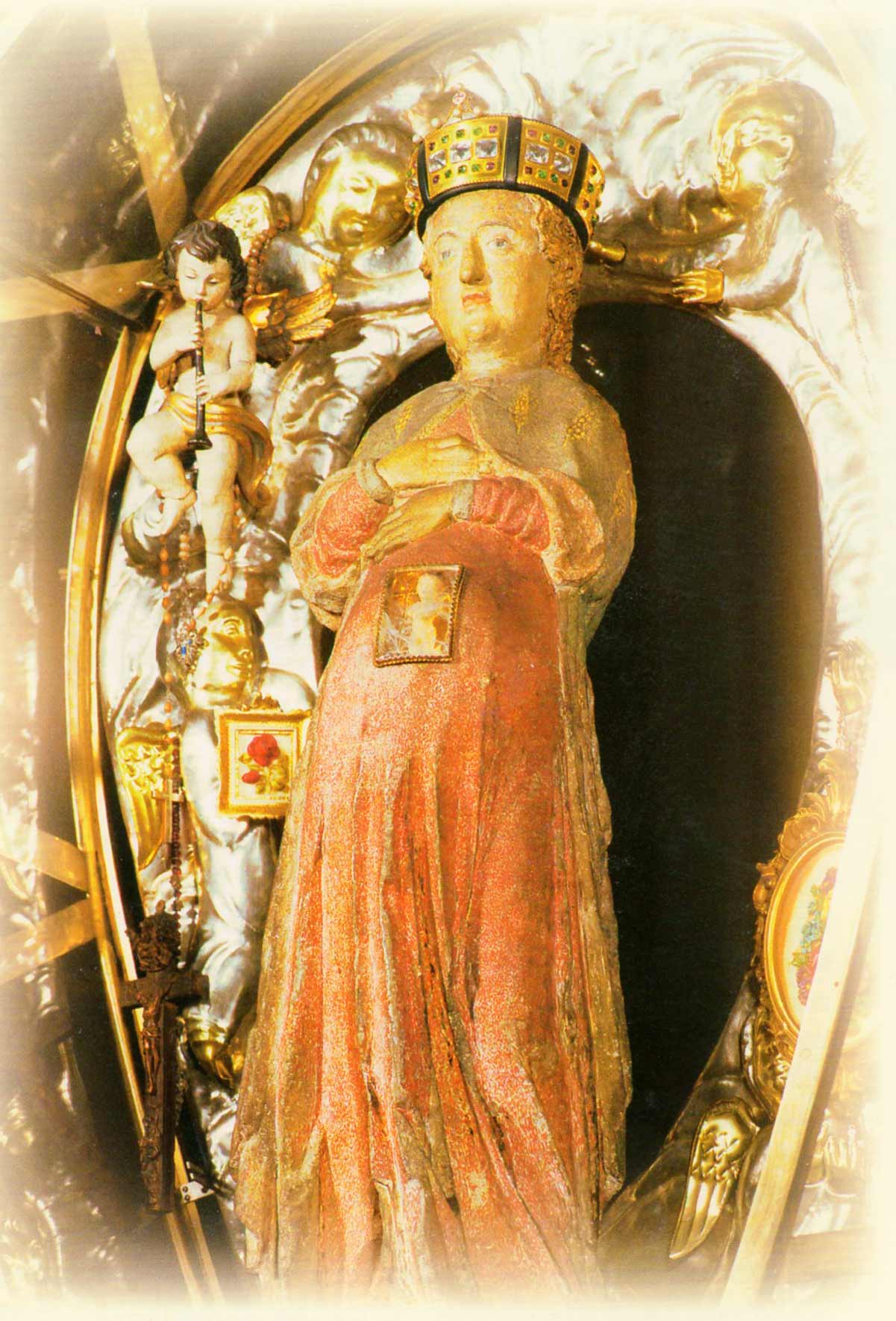
Pregnant Madonna (detail)
The Sanctuary of St. Mary of the Assumption in Altotting Bogenberg on a hill overlooking the Danube is the second largest and oldest pilgrimage site in Bavaria.
The special feature of the arc mountain church is the sculpture of the pregnant Madonna (window in the womb with baby Jesus). Bogen’s greatest claim to fame is this shrine to Mary high atop Bogenberg.
According to the legend, the Romanesque stone sculpture of Our Lady was found floating upstream on the Danube in 1104. In 1295 the chronicle of Oberalteich monastery for the first time mentions the legend of how the miracle-working statue which is revered in Bogenberg Church was found. According to that legend the statue had been floating upstream in the Danube and had landed on a rock in the river, which appears when the water level is low. This rock is still called “Marienstein”, i.e. Marys stone. Count Aswin of Bogen is said to have recovered the statue from the rock and to have taken it to the chapel of his castle. Then a church was built on Bogenberg Hill for the statue and the hill with the church was given to the monks of Oberalteich, who encouraged the pilgrimage to the miraculous statue. The statue shows Holy Mary heavy with child. It is also the reason why many of the pilgrims who came/come to Bogenberg were/are women praying for a good childbirth.
“In Advent Christ rested in Mary still, silent, helpless, utterly dependent. The Creator trusted Himself to His creature….This was a foreshadowing of what the Incarnation would mean for us; for in us too, Christ rests as He rested in Mary. From the moment when the Christ life is conceived in us, our life is intended for one thing, the expression of His love, His love for God and for the world…. We must allow the Christ life to grow in us in rest. Our whole being must fold upon Christ’s rest in us, as the earth folds upon the seed.” Caryll Houselander, The Passion of the Infant Christ (London: Sheed and Ward, 1949).
Filed under: Evangelium Vitae
AROUND THE WORLD AND THROUGH THE CENTURIES WITH THE UNBORN CHRIST CHILD
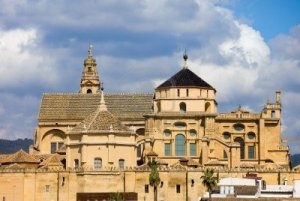
Mezquita Cathedral
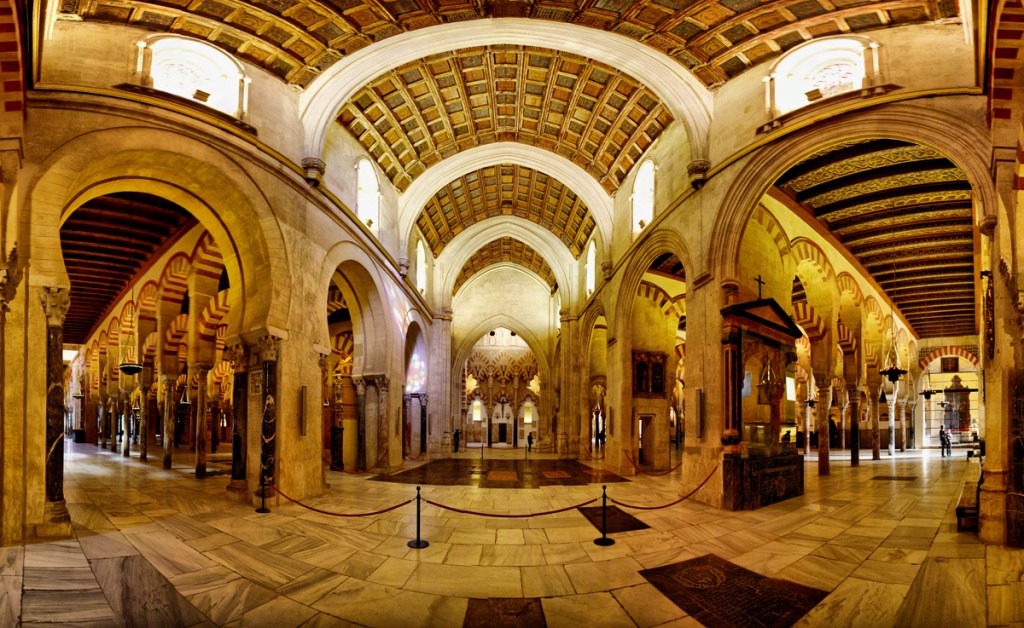
Mezquita Cathedral (Interior)
Virgin Mary “of the Sign”
Fresco of Virgin Mary “of the Sign”: she is carrying Jesus in her womb. This mural is found in The Mezquita Cathedral of Cordoba, a Roman Catholic cathedral and former mosque, situated in the Andalusian city of Córdoba, Spain. Under the rule of Islam, it was built as the second-largest mosque in the world, and is perhaps the most accomplished monument of the Umayyad dynasty of Cordoba. After the Spanish Reconquista, it was transformed into a church, and some of the Islamic columns and arches were replaced by a basilica in early Baroque style. Today it houses the main church of the diocese of Cordoba in Spain.
“He, in her, carried on the blessed converse with His Father; there was never any separation between Mary and the Blessed Fruit of her womb, Jesus. She would come back to Him with all the more joy, and tell Him what she had been doing and saying…… When we think of Jesus praying for nine months to His Father, when we think of Mary’s nine months’ colloquy with Jesus, we begin to think that there is something wrong about our methods of prayer, that they need remodeling. Let us try to understand something of what His prayer was.” Mother St. Paul, Ortus Christi (London: Longmans, Green and Co. Ltd., 1921), 90 91.
AROUND THE WORLD AND THROUGH THE CENTURIES WITH THE UNBORN CHRIST CHILD
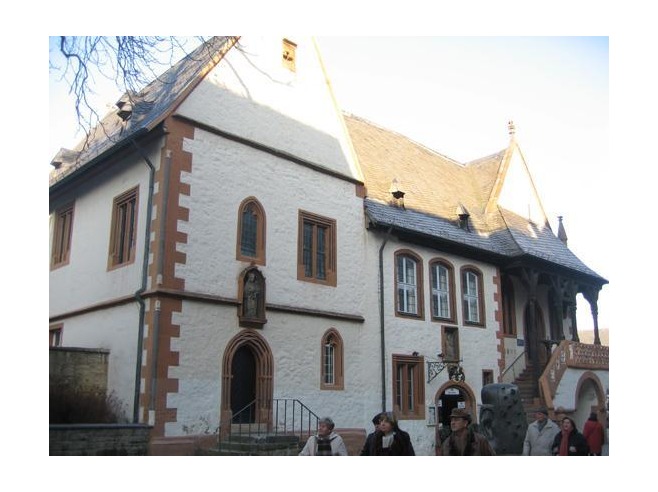 Goslar Town Hall
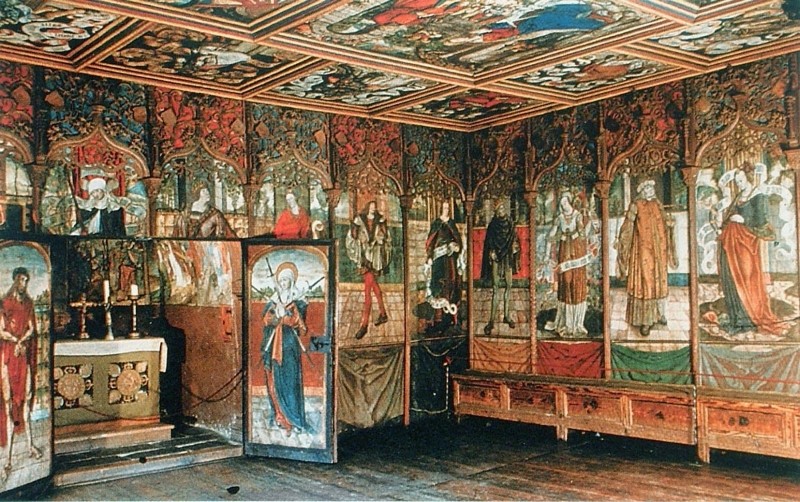
Gosler Town Hall Interior
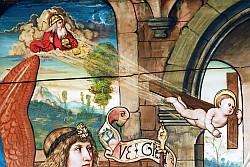
Verkündigung Mariä
The Huldigungssaal in Goslar town hall was built from 1505 to 1520 as a Council Chamber. Here is a unique gem of late Gothic art : walls, ceiling and even the window recesses are completely lined with paintings. Varied carved tendrils crown the individual whiteboards. Each and every painting is a work of art that fits in with the overwhelming impression.. It took many years but the Huldigungssaal has now been restored, with security, climate and lighting upgraded to keep this unique ensemble of artwork in pristine condition.
“The Word took possession of her chaste womb, where He was to dwell for nine months the first nine months of His sojourn on this earth. And in that temple He at once began His work, that of loving God with a human heart……All His perfect acts of love, of praise, of reverence, of service, His acts of patience and humility, of meekness and suffering, of sacrifice and mort ification and all the rest, passed up to God through Mary. From that sacred temple a fragrant incense was continually rising to heaven “a sweet smelling savor”, sweeter than either earth or heaven had ever known before. For all those acts were perfect in God’s sight, worthy of His acceptance; they were the acts of a perfect man. And they were also infinite because they were at the same time the acts of God Himself.” Mother St. Paul, Nativitas Christi (London: Longmans, Green and Co. Ltd., 1937), 145
 UNBORN WORD of the day